
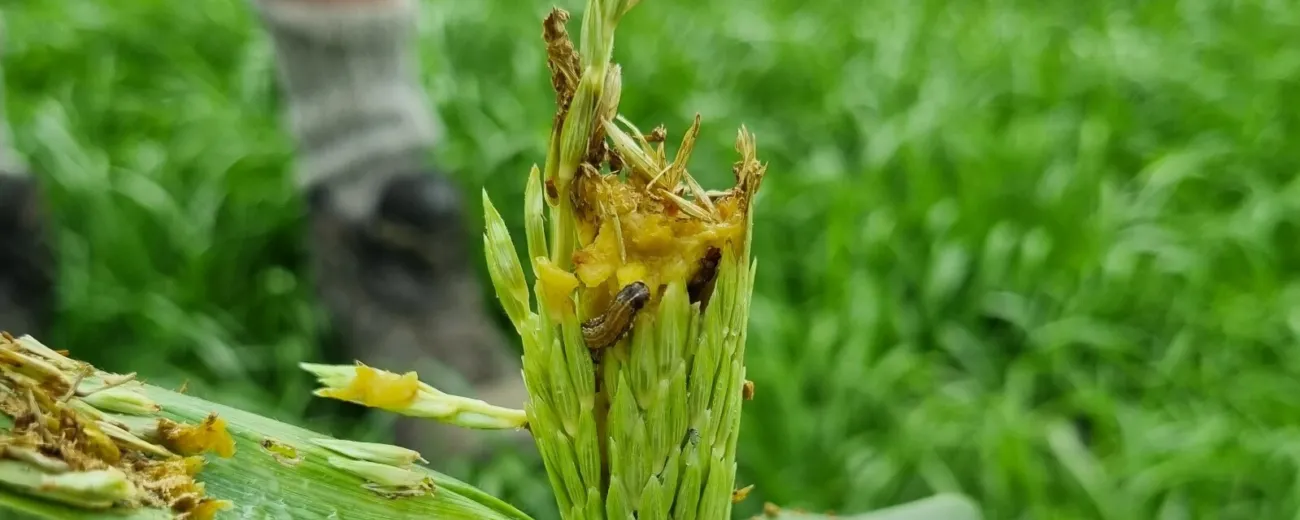
A review of New Zealand’s fall armyworm surveillance network has confirmed that crop scouting is the most reliable and informative tool for understanding fall armyworm (FAW) activity. However, it also acknowledges that scouting is time consuming and that industry personnel struggle to keep up in the height of the season.
The review, carried out as part of the Sustainable Food and Fibre Futures’ Long-term management of fall armyworm programme, assessed data from the 2024/25 season and gathered feedback from researchers, agronomists, and growers. These sources painted a clear picture of how the surveillance system is performing and where improvements can be made to strengthen FAW detection and crop protection.
Crop scouting will be the focus for any refinements to the surveillance network in the coming year.
Scouting continues to provide the most valuable insights
Across New Zealand, 196 formal scouting observations were collected during the 2024/25 season, most from maize crops in the North Island. These observations tracked crop growth stage, larval instar, crop damage, population estimates, and moth activity within paddocks.
Patterns were consistent nationwide. Damage and larval instar readings rose from early whorl to tasselling before declining as the crop matured. Larval instar proved to be the strongest indicator of expected crop damage. By contrast, population-estimate values varied widely between observers, showing that this measure is less reliable without further standardisation.
Modelling confirmed that crop stage and larval instar remain the best predictors of damage. These findings reinforce that scouting provides the most accurate and practical information for growers and agronomists making in-season decisions.
Pheromone trap show flight timing but not crop-level risk
In the Far North, bucket pheromone traps recorded a sharp increase in male moth numbers, rising from 390 moths in 2023/24 to 852 in 2024/25. Four distinct flight periods were recorded, including a large late-autumn flight in May and June.
However, trap catches did not align with larval findings in maize cobs. Some traps remained active well after harvest, long after crops had become unsuitable for infestation. Site-to-site variation was also high, influenced by wind, placement, and surrounding vegetation.
While traps remain important for understanding broad seasonal flight timing and long-term FAW behaviour, the review confirms they cannot be used to assess risk within individual paddocks.
Expert and industry feedback: Scouting must remain the priority
Feedback from Bioeconomy Science Institute (BSI) specialists highlighted the value of maintaining consistent pheromone monitoring on the same farms each year. However, the experts agreed that scouting outperforms trapping for reliability and practical decision-making, and several recommended scaling back the trap network while retaining smart traps or consistently managed traditional traps.
Growers who participate in the programme noted the value of hands-on tutorials and said that sharing their observations on the FAW website helped build confidence in crop assessments. Industry professionals also said that scouting offered a clearer picture of real in-crop activity than trap counts, especially during the fast-moving early whorl stage.
A common challenge raised across all groups was the limited time available to maintain regular scouting, particularly during peak season. Technical staff are time-poor, and achieving consistent paddock coverage can be difficult. Many stakeholders stressed that increasing grower involvement is essential, as local growers are best placed to support the network with regular observations and help fill coverage gaps.
Refinements for 2025/26
Based on the findings of the 2024/25 season, the surveillance network will adopt several refinements for the coming season:
Maintaining the core network
- Continue monitoring the same farms and regions to ensure a strong multi-year dataset.
- Keep observation methods stable for consistency.
Strengthening scouting as the primary tool
- Increase focus on scouting from early whorl to tasselling, the period when damage rises most quickly.
- Reduce the number of pheromone traps but retain a minimal and consistent set, including smart traps, to support long-term comparison.
Improving data quality
- Provide more early-season training and extension support.
- Encourage more growers to submit reports, and help reduce variation between observers.
- Promote weekly or fortnightly scouting updates during peak periods on www.fallarmyworm.nz
Using trap data appropriately
- Limit use of trap data to seasonal flight trends.
- Avoid interpreting trap spikes as indicators of local outbreak risk.
- Continue checking volunteer maize after harvest.
Monitoring off-season hosts
- Record any larvae found on grasses, including kikuyu, to support overwintering research.
Looking ahead
The 2024/25 season confirmed that scouting is the most dependable part of the FAW surveillance network. Traps remain useful for tracking seasonal moth movement, but their limitations mean they should not guide spray decisions or risk assessments on their own.
The refinements planned for 2025/26 will keep the network stable, strengthen grower engagement, and focus resources where they are most effective. This approach will provide the most accurate, consistent, and useful data to support long-term FAW management across New Zealand.
Find out more on the Fall armyworm website