
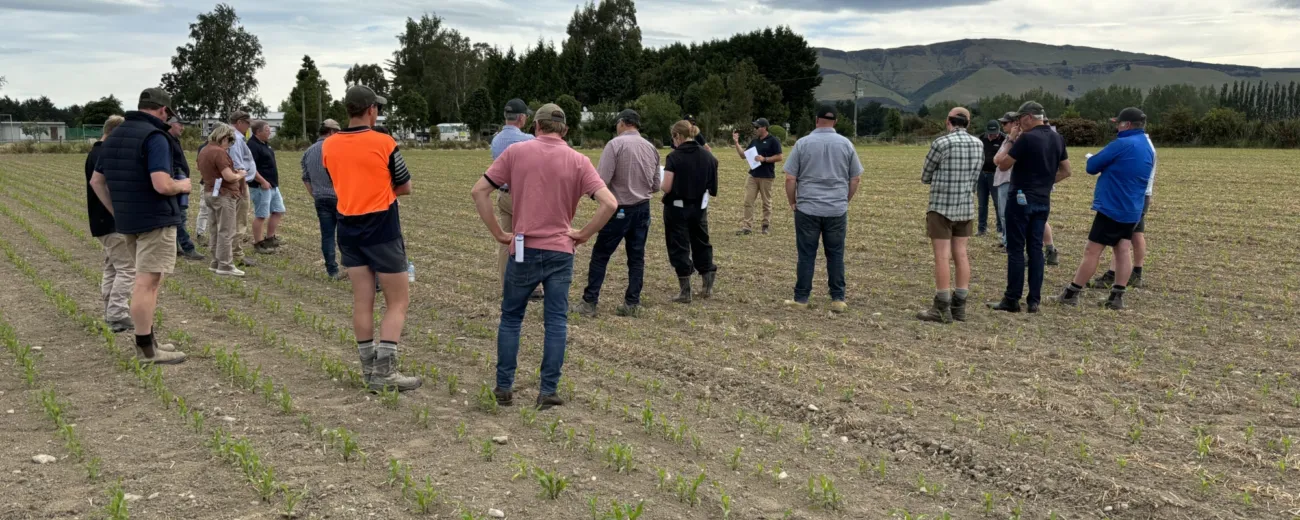
FAR's Southern Arable Research Hub at Knapdale, north of Gore, is currently entering its third season. Here’s an update of what has been going on.
In the 2024/25 season, spring barley cv. Silhouette was sown to evaluate biomass accumulation, nitrogen uptake, and grain yield. Following harvest, an oat cover crop (mix of ‘Milton’ and ‘Coronet’) was established in May before maize was planted in early November. Both the conventional and alternative blocks were sown in Pioneer P7364 maize in November. The conventional block was established using full conventional cultivation (plough, power-harrow and roll), while the alternative block was established using powered strip-till.
To date, the project has investigated reduced input systems, including lower fungicide, herbicide, and nitrogen programmes, as well as nitrogen uptake and winter nitrogen leaching losses, cultivation practices and their effects on soil properties, and the financial implications of the two management approaches. The project has faced several challenges but has provided an excellent platform to demonstrate how pushing the boundaries of agronomy can have unintended consequences if not managed appropriately.
In the first season, fungicide was excluded from the barley crop to determine whether late-planted spring barley could avoid significant late-season disease pressure during a season with low disease incidence at stem extension. The conventional block yielded 62% more than the alternative block, showing that, in that season at least, the fungicide was effective. However, the yield difference was not solely driven by disease pressure; soil compaction and increased pest damage also contributed to the reduced yields observed in the alternative system.
For the 2025/26 season, maize was planted to evaluate the potential for increased maize production in Southland. Although crop establishment was excellent and the crop looked highly promising in January, a series of frosts in early March and mid-April resulted in a less-than-ideal crop at harvest. Average yields were approximately 12 t/ha, accompanied by poor forage quality.
The 2026/27 season is now underway, with the focus shifting to milling oats.
This year, the site will be used as a demonstration comparing L5 and ‘Gardyne’ oats; the work will also contributing to the FAR Oat Monitoring Project. The trial was direct drilled on 15 May using a Cross Slot planter at 135 kg/ha seed, along with 200 kg/ha Actyva S fertiliser and 5 kg/ha slug bait. A pre-emergent herbicide application of glyphosate + 0.5 L Firebird® (400 g/L flufenacet + 200 g/L diflufenican, herbicide groups 15 and 12 respectively).
Two forage oat varieties have also been included and planted side by side: a standard variety and a variety suspected to have enhanced allelopathic properties. We will evaluate differences in weed suppression and the potential contribution of allelopathy to an integrated weed management system. Oats are known to possess allelopathic properties, releasing compounds from their root systems that can inhibit the growth of surrounding weeds. Their relatively tall growth habit also enables them to develop a dense canopy, often greater than that of wheat or barley, reducing weed competition by limiting the amount of light reaching the soil surface. FAR will continue to monitor the programme to assess the potential of different varieties to reduce weed pressure.
FAR looks forward to showcasing the project during the coming season and presenting the findings generated to date.