
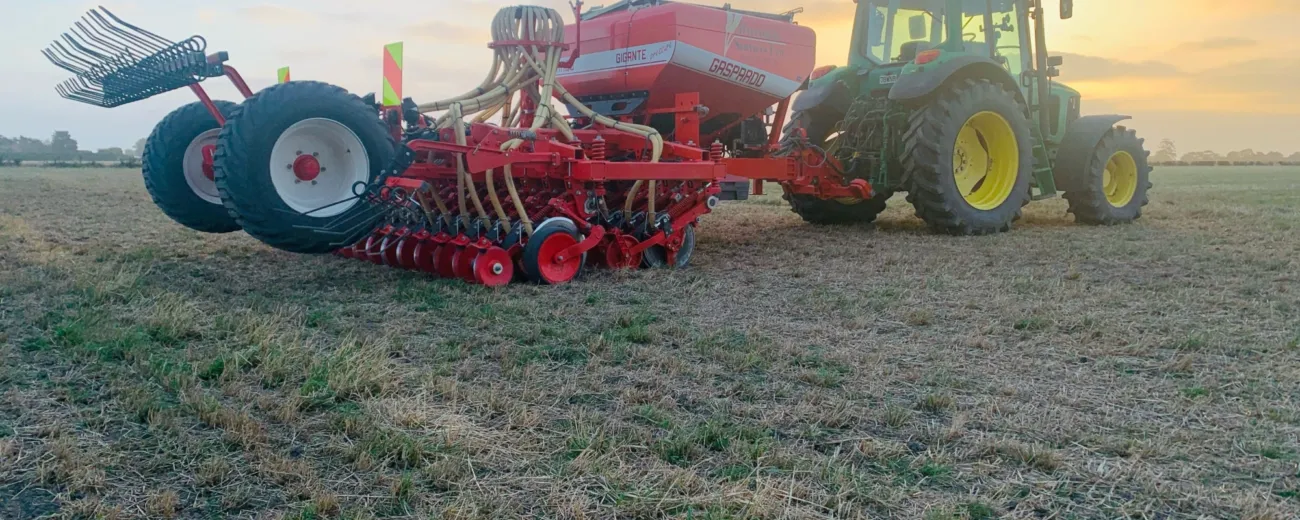
With concerns about fuel and fertiliser prices increasing, FAR Technology Manager Chris Smith has some tips for doing your best to use inputs as efficiently as possible.
Machinery choice and setup
The temptation to jump on the most comfortable or powerful machine is strong. Matching horsepower to the actual job can cut fuel use by 20 to 40 percent on lighter tasks. The difference between a 100‑horsepower tractor burning eight to ten litres an hour and a 200‑horsepower machine burning up to 20 litres adds up quickly.
Tyre pressures are also important; correcting inflation can save five to ten percent in fuel during light work and up to twenty percent for heavy machinery. Lower pressures in the paddock reduce wheel slip and improve traction, while higher road pressures reduce rolling resistance on the way home.
Even the combine harvester, often considered a fixed-cost monster, offers opportunities for efficiency. Many growers have found that by slowing the rotor or drum and opening the concave, they can lift throughput while reducing fuel use. We’ve seen examples of fuel savings of over 30 percent. When assessing losses, it pays to consider not just grain left on the ground but the cost of running the machine per hectare. In seasons of high fuel prices, crawling along to save a fraction of a percent in losses may turn out to be a false economy.Auto-steer
Manual driving inevitably means overlaps, often five to ten percent across a typical day’s work. Auto‑steer can trim that down to one to three percent. This small adjustment in accuracy brings a surprisingly large payoff. Straighter passes don’t just look tidier, they reduce throttle variation, lower operator fatigue, and keep machinery working more efficiently.
These gains are more pronounced when visibility drops, e.g. spraying at night, working with wide implements, or operating in flat, hazy light. Most farmers who move from manual steering to a decent guidance system can expect to burn five to twelve percent less diesel across a season.
Cost versus accuracy
Choose the right level of accuracy to prevent unnecessary spending. SouthPAN, which is free and works anywhere with a clear sky view, is already accurate enough for mapping tasks and jobs that don’t demand precision.
At the next level up, services like CentrePoint RTX offer near‑RTK (Real-Time Kinematics) accuracy once they have converged, making them ideal for spreading or spraying where consistent two‑to‑three‑centimetre repeatability is valuable.
Farmers wanting instant, high‑accuracy performance for tasks like precision planting or strip‑till will still find RTK hard to beat; although it’s worth remembering that RTK will never pay for itself through fuel savings alone. Its value comes from a combination of factors including time savings, reduced overlap, lower fatigue, and the ability to manage inputs more precisely.
Accuracy = efficiency
Even a basic guidance system can knock two to seven percent off chemical or fertiliser use. Adding section control can delivering savings of more than ten percent once overlap is removed on headlands and around awkward field shapes.
Variable rate application (VRA)
Across a set of typical New Zealand paddocks savings of five to 20 percent aren’t unusual, while phosphate and potash can drop by ten to 25 percent. Lime is often the standout, with well‑mapped paddocks showing reductions of 20 to 50 percent as over‑supplied zones are corrected rather than blanket‑treated. Seed savings are normally smaller but can still add up.
To make VRA genuinely effective, several pieces need to work together. Data layers based on soil sampling, canopy imagery, crop sensors, remote sensing, and yield maps provide the guidance system with real intelligence.
These layers feed into prescription software, where maps are turned into application zones and “what‑if” scenarios can be run to estimate savings before anything is applied in the field. Rate controllers, terminals, and ISOBUS systems then execute the plan, while as‑applied maps and yield monitors close the loop by showing what actually happened. The cost of upgrading to VRA‑capable equipment is usually around $20,000 over a standard machine, but in years when fertiliser prices spike, payback can come surprisingly quickly.
Optimum fertiliser application rates
The economic optimum application rate is the point at which margin-over-cost is maximised. As fertiliser prices increase, the most profitable application rate tends to drop.
These small refinements, applied consistently, can deliver significant savings. All growers can implement some of the ideas listed above and, over time, move towards using them to their full potential.